

A New Horizon in Quantum Computing
Alice & Bob, an innovative leader in fault-tolerant quantum computing, has unveiled an exciting roadmap poised to propel the future of quantum technology. By targeting the development of 200 logical qubits from 3,600 physical qubits by 2030, the company is not just doubling its previous goal; it’s reshaping the landscape of quantum computing. This ambitious plan emphasizes modular architecture, significant advancements in hardware, and applications across materials science, chemistry, and cryptography.
Understanding Cat Qubits
Central to Alice & Bob's strategy are cat qubits, a type of superconducting qubit known for their unique ability to suppress the notorious bit-flip errors at the hardware level. This technological innovation means that significantly fewer physical qubits are needed to achieve desired logical qubit performance. As Raphaël Lescanne, the CTO and co-founder, explains, “Cat qubits give an efficient path to fault tolerance,” ensuring a competitive advantage in quantum performance.
The Roadmap Milestones: A Step Towards Quantum Supremacy
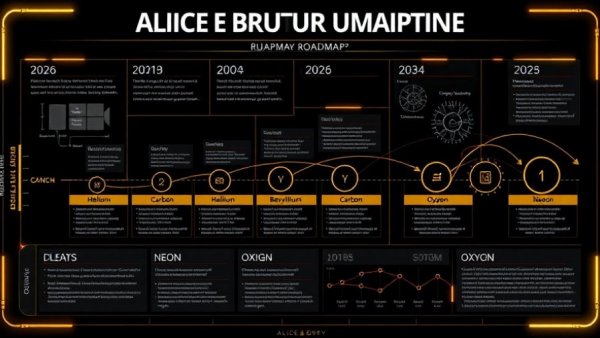
The journey to achieving 200 logical qubits is bifurcated into several key milestones:
- 2026: Helium, a prototype logical qubit designed to enable quantum error correction on real hardware.
- 2028: Beryllium, which targets the achievement of six logical qubits with the capability to run all operations required by quantum algorithms.
- 2030: Carbon, where the team aims to surpass classical computing capabilities with 200 logical qubits.
- 2032: Oxygen, to further enhance applications in cybersecurity using 1,024 logical qubits.
- 2034: Neon, where the company sets sights on an astounding 2,048 logical qubits, pushing boundaries in cryptography and complex scientific computations.
Each milestone signifies a vital progression towards practical quantum applications, showcasing not only ambition but also a structured approach to innovation.
Harnessing Collaboration for Scalability
This modular architecture acts as a catalyst, connecting multiple quantum processors (QPUs) operating at cryogenic temperatures. This method helps to bypass the limits of traditional single cryostat systems while providing flexibility to adapt to varying machine sizes. Early success in collaborative projects, such as those under France’s PROQCIMA program, demonstrates Alice & Bob's proficiency in assembling and operating independent QPUs which is foundational for reaching their ambitious goals.
Real-World Applications of Quantum Breakthroughs
With every advancement in logical qubit capacity, new applications arise. For example, by surpassing classical computing limitations in 2030, Alice & Bob will unlock capabilities in materials science, such as modeling complex spin systems like the Hubbard and Ising models. By 2032, the focus shifts to enhancing cybersecurity measures, critical as digital threats evolve alongside technological advancements. In essence, the roadmap not only speaks to quantum computing possibilities but to tangible solutions for current global challenges.
The Role of AI in Quantum Development
The interplay between artificial intelligence and quantum computing is also noteworthy. As stated by Jérémie Guillaud, VP of Firmware, innovative AI tools are streamlining the design and fabrication processes. The integration of AI allows for faster experimentation and the development of more efficient quantum algorithms, marking a new era where AI could serve as a driving force in overcoming obstacles within quantum technology.
Conclusion: What Lies Ahead for Quantum Computing
As Alice & Bob embarks on this transformative journey, the implications for industries and society are profound. Their roadmap not only outlines a path for technological growth but also highlights the collaborative spirit driving innovation in quantum computing as a whole. Understanding these advancements will be integral for industries aiming to leverage quantum technologies’ potential—including finance, healthcare, and environmental science.
In embracing the future of quantum computing, stakeholders across sectors must remain engaged with these developments to remain competitive in an era defined by rapid technological evolution.







Write A Comment